
Every Australian who grows food, hunts, forages, or simply wants to take control of what their family eats eventually faces the same question: how do I stop good food from going to waste?
Traditional preservation methods — canning, dehydrating, pickling, and fermenting all work - but each one forces a trade-off.
Freeze drying changes that equation entirely. It is the only preservation method that removes moisture from food while retaining virtually all of its original nutrition, flavour, colour, shape, and texture. The result is shelf-stable food that can last 25 years or more when stored correctly — and rehydrates in minutes to something remarkably close to fresh.
Once confined to NASA missions, military rations, and pharmaceutical manufacturing, freeze drying technology is now accessible to everyday households. For anyone committed to self-sufficiency, emergency preparedness, or reducing food waste, a home freeze dryer is one of the most impactful investments you can make.
Understanding the Science of Freeze Drying
What Is Freeze Drying (Lyophilisation)?
Freeze drying — known in scientific and industrial contexts as lyophilisation — is a low-temperature dehydration process that removes water from a product by first freezing it, then reducing the surrounding pressure and applying gentle heat so that the frozen water transitions directly from a solid (ice) to a gas (water vapour). This phase transition is called sublimation.
Because the water is never in a liquid state during removal, the cellular structure of the food remains intact. This is why freeze-dried strawberries keep their shape, colour, and crunch, while traditionally dehydrated strawberries become flat, dark, and leathery.

Research published in the International Journal of Molecular Sciences confirms that freeze drying is widely regarded as one of the best methods for preserving bioactive compounds, antioxidants, and vitamins in foods, outperforming both hot-air drying and spray drying in retention of sensitive nutrients. The process is used not only in food production but also in pharmaceuticals, biotechnology, and materials science, precisely because of its ability to maintain structural and chemical integrity.
The Three Stages of Freeze Drying
Freezing (Pre-Freeze Phase)
The food is placed on trays inside the vacuum chamber and frozen to very low temperatures, typically between −30°C and −50°C. The goal is to freeze all water within the food into solid ice crystals. Rapid, uniform freezing produces smaller ice crystals, which cause less damage to cell walls — this is one reason machines with powerful refrigeration compressors produce better results.
Primary Drying (Sublimation)
Once frozen, the vacuum pump reduces air pressure inside the chamber to very low levels — often below 0.1 millibars. Under this deep vacuum, with gentle heat applied to the trays, the ice crystals sublimate directly into water vapour without passing through a liquid phase. The vapour travels to the condenser where it refreezes and collects as ice. This stage removes roughly 90–95% of the water content and is the longest phase, typically taking 12 to 24 hours.
Secondary Drying (Desorption)
After sublimation removes the free ice, some water molecules remain bound to the food's molecular structure. The temperature is raised slightly while the vacuum is maintained, releasing these tightly bound molecules through desorption. Total moisture is reduced to between 1% and 4% — the range needed for maximum shelf stability. By comparison, conventional dehydration only reaches 10–15% moisture.
Why Sublimation Matters
When water is removed by evaporation (as in conventional dehydrators), it passes through a liquid phase. Liquid water moving through food collapses cell walls, concentrates sugars, and causes the shrunken, tough texture you see in raisins, beef jerky, or dried apple rings.

In sublimation, the ice leaves behind the same void it occupied when frozen — preserving the food's original porous structure. When you add water back to freeze-dried food, it rehydrates rapidly and returns to something very close to its fresh state.
Freeze Drying vs. Other Preservation Methods

The table below summarises how freeze drying compares to other common preservation methods across the factors that matter most.
| Factor | Freeze Drying | Dehydrating | Canning | Freezing |
|---|---|---|---|---|
| Nutritional Retention | Retains 97%+ of vitamins, minerals, polyphenols, and antioxidants. Protects heat-sensitive nutrients (vitamin C, B-complex, folate). | Moderate loss. Prolonged heat (50–70°C) degrades vitamin C, B vitamins, and antioxidants. | Significant loss. High-temperature processing (100°C+) destroys heat-sensitive vitamins. | Good short-term retention; nutrients degrade progressively from ice crystal damage and oxidation. |
| Shelf Life | Up to 25 years in Mylar bags with oxygen absorbers. Moisture reduced to 1–4%. | 1–2 years. Residual moisture (10–15%) limits stability. | 2–5 years. Quality and nutrition decline over time. | Indefinite safety, but progressive quality loss. Completely dependent on uninterrupted power. |
| Texture & Taste | Rehydrated food is remarkably close to fresh. Also delicious eaten dry as crunchy snacks. | Chewy, leathery, or brittle. Rehydration doesn't restore original texture. | Soft, often mushy. Heat processing fundamentally changes structure and flavour. | Closest to fresh when thawed quickly, but ice crystals cause texture loss. |
| Weight & Portability | Removes up to 99% of water weight. 1 kg fresh → ~100–200 g. Ideal for travel and emergency kits. | Removes 80–90% of water. Lighter than fresh but heavier than freeze-dried. | Heavy. Water remains in product, plus jar/can weight. | Full original weight. Requires insulated transport. |
| Power Dependency | Power needed only during drying cycle (20–36 hrs). Zero ongoing energy once sealed. | Power needed only during drying. No ongoing energy for storage. | Power needed only during processing. No ongoing energy for storage. | Continuous electricity required 24/7. Outage can destroy months of food. |
| Equipment Cost | Higher upfront ($6,999–$15,999), but lowest long-term cost per year of food preserved. | Low ($50–$500). | Moderate ($100–$500 for canners, plus ongoing jars/lids). | Moderate ($500–$2,000 for freezers), plus ongoing electricity. |
How a Home Freeze Dryer Works
The Machine Itself
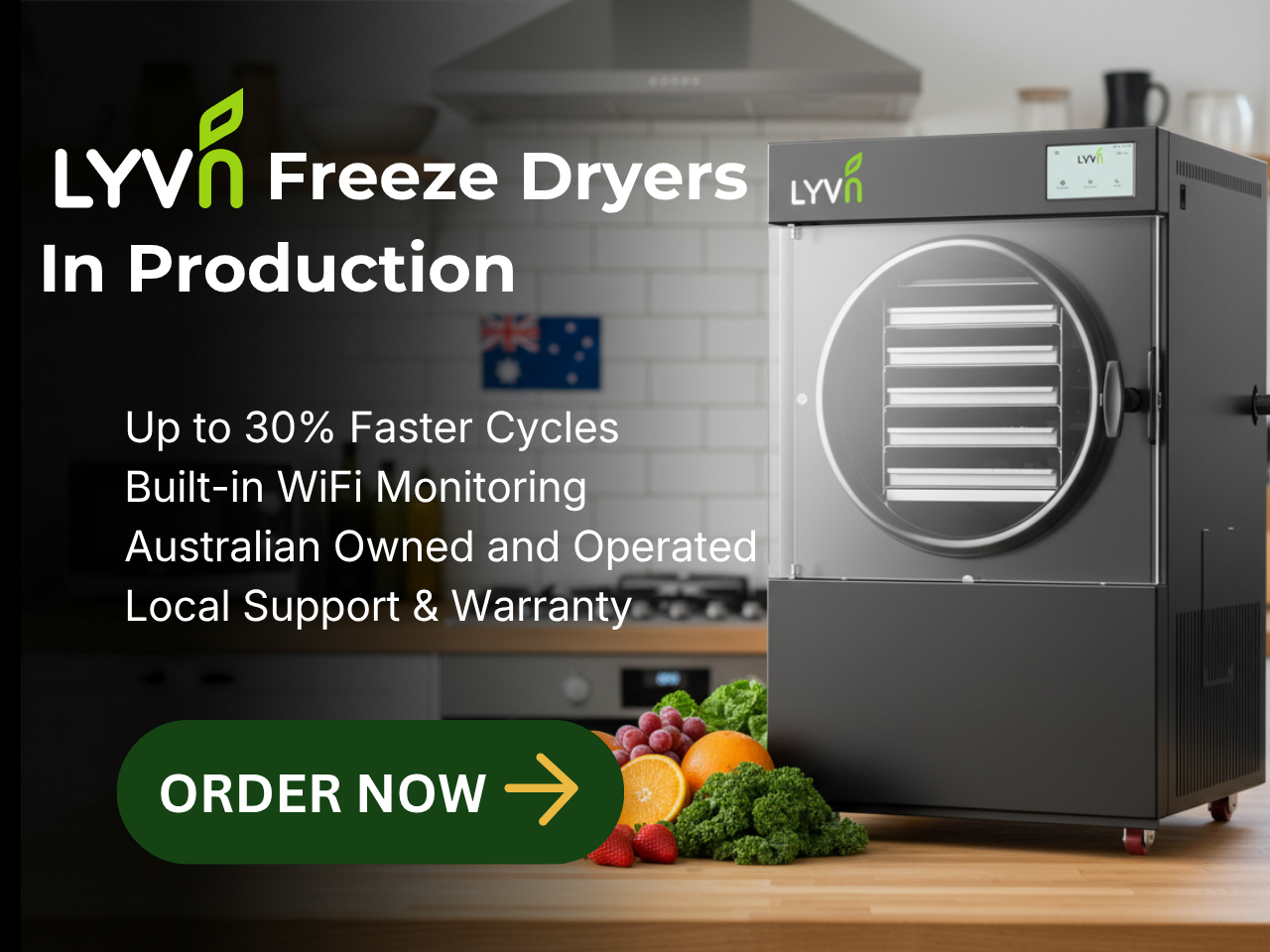
A modern home freeze dryer is roughly the size of a small to medium-sized bar fridge. It consists of four main components working together:
The vacuum chamber is a sealed, food-grade stainless steel compartment where the food sits on removable trays, capable of withstanding deep vacuum pressure.
The refrigeration system (compressor and condenser coils) freezes the food and maintains the cold condenser surface that captures water vapour.
The vacuum pump creates and maintains the very low pressure required for sublimation — industrial-grade pumps deliver more consistent vacuums and faster drying.
The control system automates the entire cycle via a digital touchscreen or programmable panel.

The Process in Practice
Using a home freeze dryer is far simpler than its underlying science might suggest. You prepare your food — slicing fruits, cooking meals, portioning meats, or arranging herbs — and spread it on the stainless steel trays. The trays slide into the chamber, you close the door, and start the cycle. The machine handles everything from there: freezing, pulling the vacuum, managing heat, and alerting you when complete.
Once finished, you remove the trays of lightweight, crispy food and package it immediately in airtight containers. Properly sealed, this food is now shelf-stable for decades, requires no refrigeration, and is ready to eat dry or rehydrated with water.
What Can You Freeze Dry?

Very few foods don't freeze dry well. Pure fats and oils, very high-sugar jams, and high-alcohol products don't sublimate effectively. Nearly everything else is fair game.
Freeze Drying and Self-Sufficiency
For those pursuing self-sufficiency — whether on a rural homestead, a suburban block with a productive garden, or simply a household committed to reducing dependence on supermarkets and supply chains — a freeze dryer becomes the centrepiece of your food preservation system.
Seasonal Harvest Preservation
Process the glut — stone fruits in summer, citrus in winter, tomatoes in autumn — and store them in peak condition for years. Convert excess produce into a shelf-stable asset your family draws on year-round.
Emergency Preparedness
Supply chain disruptions, bushfires, floods, and cyclones are real and recurring. Unlike a freezer that becomes a liability during a blackout, freeze-dried food requires no power, no refrigeration, and no special storage conditions.
Reducing Food Waste
The average Australian household wastes $2,000–$2,500 of food annually. A freeze dryer lets you rescue overripe produce, marked-down meat, and leftovers — converting them from future landfill into long-term food assets.
Whole-Food Lifestyle
When you freeze dry your own food, you know exactly what's in it. No preservatives, no additives, no mystery ingredients. Full control over nutrition for families managing allergies, dietary needs, or a clean-eating commitment.
Getting Started — Practical Considerations
Space and Setup
A home freeze dryer requires a dedicated space with good ventilation, a standard Australian 240V power outlet, and enough room for airflow. Most medium-sized units have a footprint similar to a small bar fridge. Garages, laundry rooms, and dedicated pantry spaces are popular choices.
Running Costs
A typical cycle uses roughly 8 to 16 kWh of electricity depending on machine size and load. At average Australian electricity rates, this works out to approximately $3 to $7 per batch — a small cost given that each batch can produce several kilograms of shelf-stable food.

Learning Curve
Modern freeze dryers are designed to be straightforward. Most people run successful batches within their first week. Over time, you'll develop intuition for food preparation that optimises results. OzFarmer provides ongoing support, guides, and a community of Australian freeze-drying enthusiasts.
Storage and Packaging
Investing in proper packaging is essential. Mylar bags with oxygen absorbers are the standard for long-term storage. Mason jars with vacuum-sealed lids work well for items you'll rotate through within a year or two. OzFarmer stocks a complete range of storage supplies alongside their freeze dryers.

The Smartest Investment in Your Food Future
Whether you are a homesteader processing your harvest, a family wanting to eliminate food waste, a prepper building a long-term food store, or an outdoor enthusiast who wants lightweight trail food — freeze drying delivers what no other preservation method can.
Explore Freeze Dryers at OzFarmer → Shop All ProductsSources and Further Reading
- Healthline: "Freeze-Drying: How It Works, Benefits, and Downsides" — healthline.com
- International Journal of Molecular Sciences (PMC): "Freeze-Drying Technology in Foods" — pmc.ncbi.nlm.nih.gov
- Millrock Technology: "What Is Freeze Drying?" — millrocktech.com